AI 快速回答
Rights workflows should be documented before release, not reconstructed during a dispute.
- Save license PDFs or screenshots with timestamps.
- Keep split sheets and contributor approvals in the project folder.
- Record territory, term, allowed uses, and payment terms for each asset.
This is operational education for producers, not legal advice. For a signed deal, dispute, takedown, or high-value sync, ask a qualified music lawyer in the relevant territory.
Localization note
Legal, tax, privacy, rights, royalty, and contract guidance changes by jurisdiction. Treat this article as an editorial starting point, not legal or accounting advice.
For Traditional Chinese readers in Taiwan, Hong Kong, and Macau, verify local payment rails, tax paperwork, platform access, rights administration, and consumer rules instead of reusing mainland or US defaults.
快速解答
Song splits refer to the percentage of royalties allocated to each contributor of a song, including writers, producers, and artists. A typical split is 50% for the publisher (writers) and 50% for the record label (artists and producers), but this can vary depending on the agreement.
What are Song Splits?
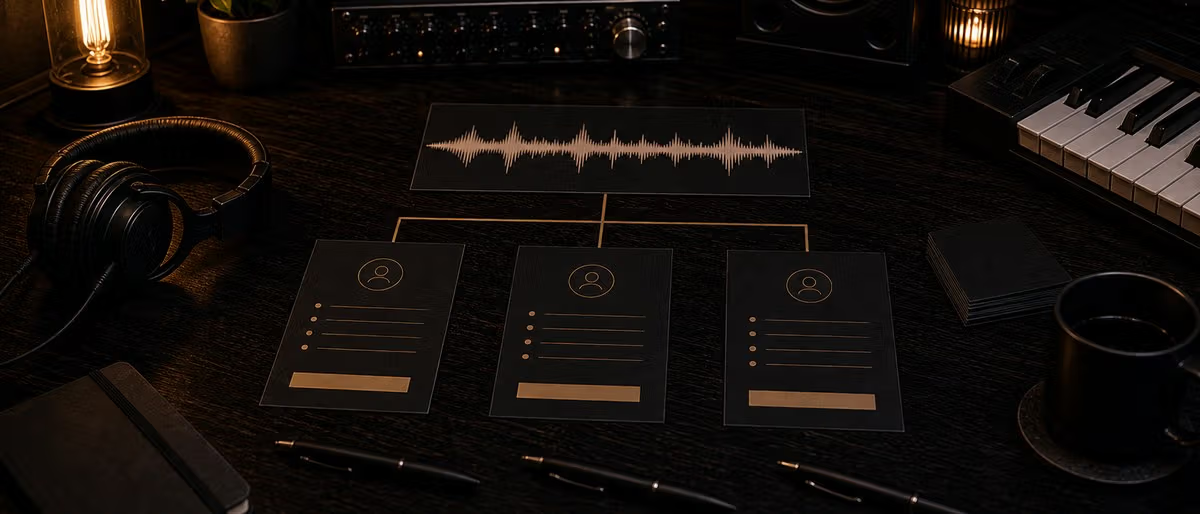
Song splits, also known as royalty splits, refer to the percentage of royalties allocated to each contributor of a song. This includes writers, producers, and artists who have contributed to the creation and production of the song.
Song splits are an essential aspect of the music industry, as they determine how royalties are distributed among the various stakeholders involved in the creation and production of a song.
A credit line, DM, beat-store receipt, or friendly verbal yes can be useful evidence, but it is not the same as a license that names the rights and permitted exploitation.
Composition split
Who wrote the song or beat and what percentage each writer controls.
Producer action Agree to total 100 percent before distribution.
Master split
Who owns or participates in the sound recording revenue.
Producer action Separate it from publishing in the sheet.
Admin rights
Who can register, license, pitch, and approve changes.
Producer action Name the person or company and require notice for major uses.
Types of Song Splits
如何製作 Split Royalties
| Territory | Operational caution |
|---|---|
| US | Separate master, composition, mechanical, performance, sync, and DMCA processes. SoundExchange applies to non-interactive digital performance royalties for recordings. |
| EU/EEA | Moral rights and collective-management rules can be stricter than a US-only workflow. Platform takedowns and neighboring rights can involve local societies. |
| UK | PRS, MCPS, and PPL often sit in different parts of the rights stack. Do not assume a US PRO registration covers UK exploitation cleanly. |
| Brazil | ECAD and local publishing administration can affect public performance and neighboring-right collections. Portuguese contract language may matter. |
| Russia | Local collection and enforcement conditions can change quickly. Keep contracts, source files, and payment evidence in case platforms request proof. |
| China | Platform clearance, lyric use, and local distribution rules may require local partner review before release or sync use. |
| Japan/Korea | JASRAC, NexTone, KOMCA, and local neighboring-right workflows can be precise about splits, covers, and sync. Metadata accuracy matters. |
| Turkey/Indonesia | Local collecting societies and platform policies may diverge from US templates. Confirm language, term, and territory in writing. |
| Spanish multi-region | Spain, Mexico, Colombia, Argentina, Chile, and other Spanish-speaking markets are not one legal region. Use country-specific review for campaigns. |
| Arabic multi-region | MENA markets vary by country, platform, and local partner. Treat Arabic-language exploitation as multi-territory unless a contract says otherwise. |
Example of Song Splits
Importance of Fair Royalty Distribution
This is operational education for producers, not legal advice. For a signed deal, dispute, takedown, or high-value sync, ask a qualified music lawyer in the relevant territory.
Ready to distribute your music?
瀏覽免費下載Learning path
Related answer hubs
常見問題
- What is a typical song split?
- A typical song split is 50% for the publisher (writers) and 50% for the record label (artists and producers).
- How do I negotiate a song split?
- Negotiating a song split involves discussing and agreeing on the percentage of royalties to be allocated to each party involved in the creation and production of the song.
- What happens if there is a dispute over song splits?
- If there is a dispute over song splits, it can lead to conflicts among the parties involved, which can negatively impact the success of the song and the relationships among the parties.
- Can song splits be changed after they are agreed upon?
- Yes, song splits can be changed after they are agreed upon, but it requires the agreement of all parties involved.